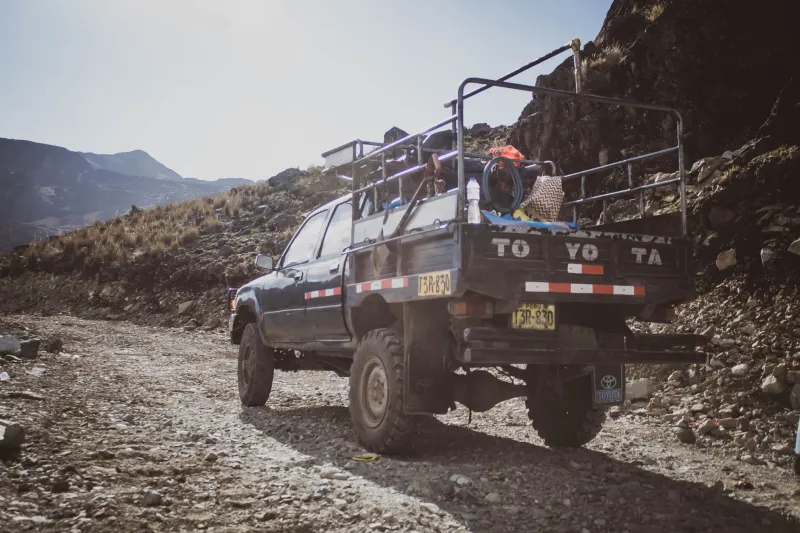
Dirt Roads and Clear Heads: The Real Science Behind Why Off-Road Adventures Are Good for Your Brain

Photo by Photo by Michael Hystead on Unsplash on Unsplash
Something shifts when the pavement ends. You feel it in your chest before you can explain it with words—a kind of loosening, like a fist slowly unclenching. The trail demands your attention in a way that a spreadsheet or a group chat simply never will. And according to researchers, therapists, and a growing number of neuroscientists, that shift isn't just in your imagination.
Off-road driving and backcountry exploration are doing measurable, meaningful things to the human brain. Whether you're crawling a rocky switchback in Moab or threading a forest two-track in the Pacific Northwest, your mind is working in ways that desk life rarely asks of it—and healing in ways that conventional stress relief often can't touch.
Let's break down what's actually happening up there.
Your Brain on the Trail: The Stress Response Flipped Upside Down
Chronic stress is one of the defining health crises of modern American life. Cortisol—the body's primary stress hormone—runs high in people who spend long hours in sedentary, screen-heavy environments. Over time, elevated cortisol is linked to anxiety, depression, impaired memory, and even cardiovascular problems.
Here's where it gets interesting: exposure to natural environments has been repeatedly shown to reduce cortisol levels. A landmark study out of the University of Michigan found that just 20 to 30 minutes spent in a natural setting caused a significant drop in cortisol. And that's for a walk in the park. Now imagine a full day navigating remote terrain.
But off-roading adds another layer that a passive nature walk doesn't. It demands active engagement. You're reading the trail, managing throttle and traction, anticipating obstacles, and making real-time decisions. That kind of focused attention—what psychologists call a "flow state"—essentially crowds out rumination. Your brain literally doesn't have bandwidth left over for whatever was eating at you back home.
Adventure therapist and licensed counselor Dana Reyes, who runs wilderness-based therapy programs in Colorado, puts it plainly: "When someone is genuinely focused on navigating a challenging trail, they're not dissociating or numbing out—they're fully present. That presence is therapeutic in itself. It's what a lot of talk therapy spends weeks trying to achieve."
The Confidence Loop Nobody Talks About
One of the quieter mental health benefits of off-road adventures is what happens to your self-efficacy—your belief in your own ability to handle difficult situations.
Every time you make it through a gnarly section of trail, recover from a slide, or problem-solve a mechanical issue miles from the nearest cell tower, your brain logs that as evidence. Evidence that you are capable. That you can figure things out. That hard situations don't have to break you.
This isn't motivational poster stuff. It's backed by decades of research in cognitive behavioral psychology. Albert Bandura's foundational work on self-efficacy showed that "mastery experiences"—successfully completing challenging tasks—are the single most powerful way to build lasting confidence.
Long-time off-roader Marcus Tillman, who's been running trails across the American Southwest for over fifteen years, describes it this way: "The first time I got my truck unstuck on my own out in the Arizona desert, I felt like I could handle anything. That feeling followed me home. It still does."
This is why so many people come back from off-road trips feeling different—not just relaxed, but sturdier somehow. More capable. More themselves.
Decision Fatigue, Meet Your Match
Modern life is a relentless parade of low-stakes decisions. What to eat, what to watch, what to reply, what to buy. Research from Columbia University suggests that the average American makes roughly 35,000 decisions per day. Most of them are trivial. And that triviality is exhausting in its own particular way.
On the trail, decisions are fewer but they actually matter. Do you take this line or that one? Do you air down more before this section? Do you push on or make camp? These are real choices with real consequences, and your brain responds to them differently than it does to the noise of daily life.
Neurologist Dr. Priya Anand, who studies the effects of environmental stimulation on executive brain function, notes that "challenging natural environments activate the prefrontal cortex in ways that routine activities simply don't. You're exercising the parts of the brain responsible for planning, risk assessment, and adaptive thinking. It's a legitimate cognitive workout."
In other words, off-roading isn't just fun—it's keeping your decision-making faculties sharp.
Disconnection as a Feature, Not a Bug
There's a reason the phrase "getting away from it all" exists. Digital disconnection—the kind that happens naturally when you're forty miles from the nearest cell tower—has its own emerging body of research behind it.
A study published in PLOS ONE found that backpackers who spent four days in nature without digital devices performed 50% better on creative problem-solving tasks afterward. The researchers attributed this to what they call "attention restoration theory"—the idea that natural environments replenish the directed attention we burn through during screen-heavy work.
Off-road adventures, almost by definition, take you to places where your phone stops being useful. That's not a limitation. That's the point.
How to Actually Maximize These Benefits on Your Next Trip
Knowing the science is one thing. Putting it to work is another. Here are a few practical ways to make sure your next trail run delivers the mental reset you're after:
Go further than comfortable. The benefits compound with challenge. A mild gravel road is relaxing; a genuine technical trail is transformative. Push yourself a little further than feels easy.
Leave the itinerary loose. Over-scheduling kills spontaneity and reintroduces the kind of time pressure that drives stress in the first place. Build in buffer time and give yourself permission to linger somewhere unexpected.
Ditch the devices intentionally. Don't just let your phone die—actively choose to put it away. The shift in your awareness is noticeably faster when it's a deliberate choice.
Bring the right rig. Nothing tanks the mental health benefits of a backcountry trip faster than a vehicle that's not up to the terrain. Anxiety about mechanical failure or getting stuck in the wrong vehicle is real, and it works against everything else on this list. Renting a purpose-built off-road vehicle means you're not white-knuckling it through sections that should feel exciting, not terrifying.
Go with people who get it—or go alone. Group dynamics matter. Bring people who are genuinely present on the trail, not counting the hours until they're back in Wi-Fi range.
The Bottom Line
Off-road adventures have always felt good. Now we know more about why. The combination of natural immersion, physical engagement, real-stakes decision-making, and digital disconnection creates a set of conditions that modern neuroscience and psychology increasingly recognize as genuinely restorative.
You don't need a therapist's referral to go find a trail. You just need the right vehicle and the willingness to let the pavement end.
The wild has always been out there. Turns out, it's been waiting to do you some good.